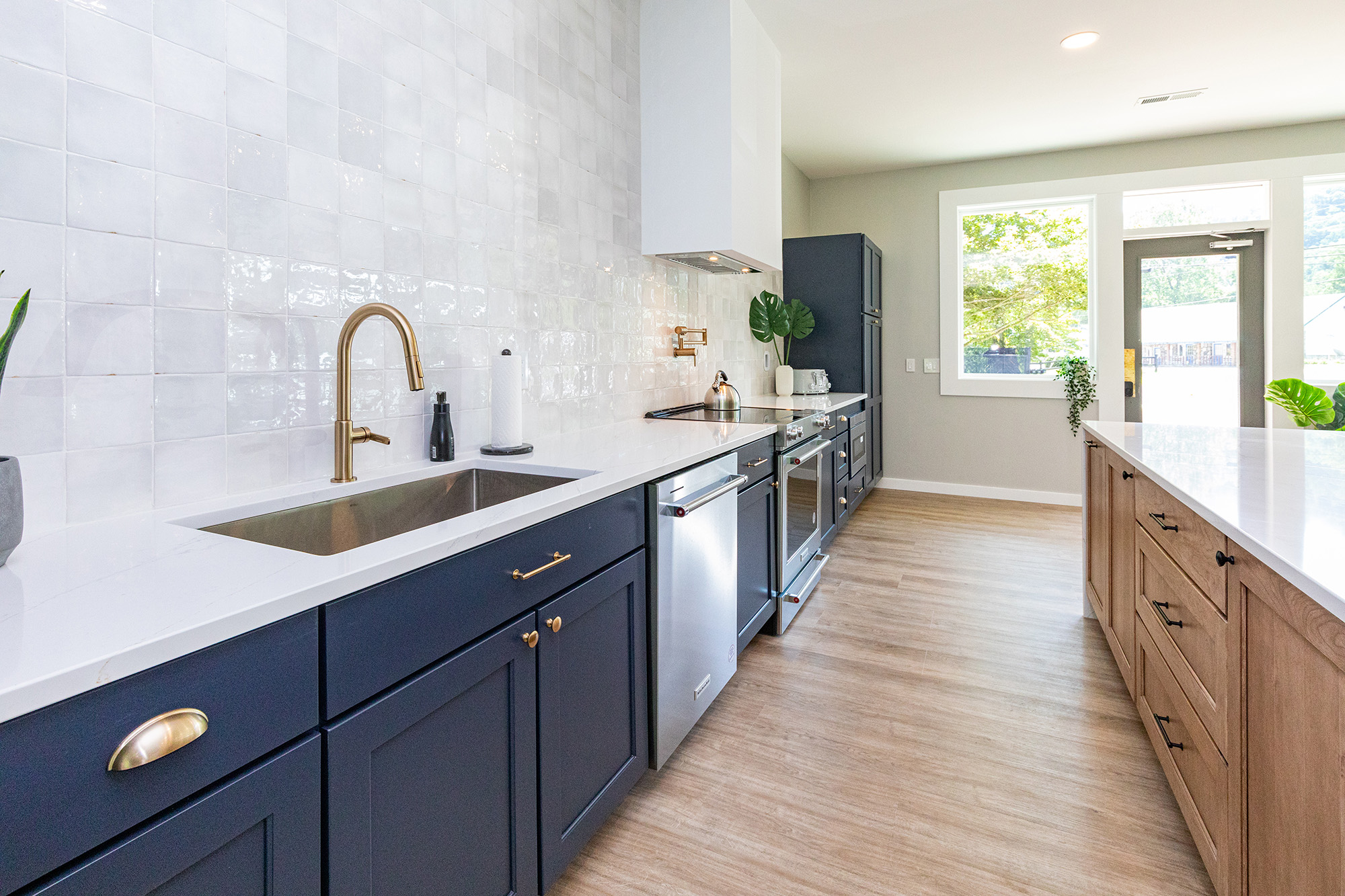
The Assumption That Keeps Engineered Off the List
A lot of homeowners hear engineered hardwood and assume it means a lesser product, something chosen only when solid wood is not an option. That assumption skips over the actual reason engineered hardwood exists in the first place, which is a plywood or high density core built specifically to handle conditions solid wood struggles with.
Kitchens built over a concrete slab, which is common in additions and single story sections of many South Suburban homes, are exactly that kind of condition. Solid hardwood is not recommended directly over a slab in most cases because of how moisture moves through concrete, while engineered hardwood's layered core is built to handle that environment without the same risk.
What a Slab Kitchen Actually Needs Underneath
Concrete slabs release moisture vapor over time, even when they seem completely dry to the touch, and that slow release is exactly what causes solid hardwood to cup or warp when installed directly on top without the right barrier. Engineered hardwood's cross layered core resists that kind of moisture driven movement far better, since the structure itself is designed to counteract expansion in any single direction.
This is the detail that gets lost in most flooring conversations, where solid versus engineered gets framed purely as a durability or price comparison. In a slab kitchen specifically, engineered is often the technically correct choice rather than a compromise, which changes the entire framing of the decision.
Why Kitchens See More Temperature And Moisture Swings Than People Expect
A kitchen deals with more localized humidity and temperature change than almost any other room in the house, between dishwasher steam, stovetop heat, and the occasional spill near the sink. Engineered hardwood's layered construction handles this kind of repeated, localized change more predictably than solid wood, which expands and contracts as a single solid piece.
This does not mean solid hardwood cannot work in a kitchen under the right conditions, particularly in kitchens with a traditional wood subfloor rather than a slab. It simply means the decision should be based on what is underneath the kitchen and how the space actually gets used, not a blanket rule in either direction.
The Refinishing Trade Off Worth Understanding Upfront
The most common hesitation around engineered hardwood is refinishing potential, since people assume it cannot be sanded the way solid wood can. Many engineered products today have a wear layer thick enough to be lightly refinished at least once, though this varies significantly by product and is worth confirming on the specific plank being considered.
Solid hardwood generally offers more total refinishing cycles over its lifetime, and that is a fair trade off to weigh honestly rather than gloss over. The right answer often comes down to what the subfloor allows in the first place, since a slab kitchen removes solid wood from consideration before refinishing cycles even become the deciding factor.
What to Look for When Choosing an Engineered Product
Wear layer thickness is the single most important spec to check, since it determines both refinishing potential and how the floor holds up to daily kitchen traffic over time. A thicker wear layer generally means more flexibility down the road, even if it costs a bit more upfront.
Core construction matters just as much as the top layer. A plywood core with more cross layered plies typically offers better stability than a lower ply count core, which is worth asking about directly rather than assuming all engineered products are built the same way underneath the surface finish. Our hardwood flooring selection includes engineered options with wear layers and core constructions suited to kitchen use.
Landmark Flooring has helped homeowners across Tinley Park, IL, Orland Park, IL, Naperville, IL, Oakbrook, IL, and Chicago, IL work through exactly this kind of slab kitchen and moisture consideration before choosing a product. Stop by Tinley Park, IL in Tinley Park to compare engineered hardwood constructions in person, or contact us for a free in home estimate that accounts for what is under your kitchen floor.